


In which areas does food waste actually occur in contract catering?
In contract catering, food waste is rarely caused by a lack of care. The real challenge lies much earlier in the production planning process.
In contract catering, large quantities of food are produced daily amid a high degree of uncertainty. Every morning, the kitchen has to decide how many portions to prepare before it is clear how many guests will actually show up for lunch. Perhaps more employees are working from home today. Perhaps it’s raining and fewer people are leaving their offices. Or perhaps the vegetarian dish is proving much more popular than expected. At the same time, if the most popular dish sells out by 12:30 pm, guests will be dissatisfied. So it’s better to plan a little more generously, which means more food is produced than is needed.
This overproduction is understandable, and even the obvious choice from the kitchen’s perspective. However, it also demonstrates that the root of the problem lies in the data used to inform this decision every morning, rather than in the behaviour of the employees.
How big is the problem really? Facts and figures
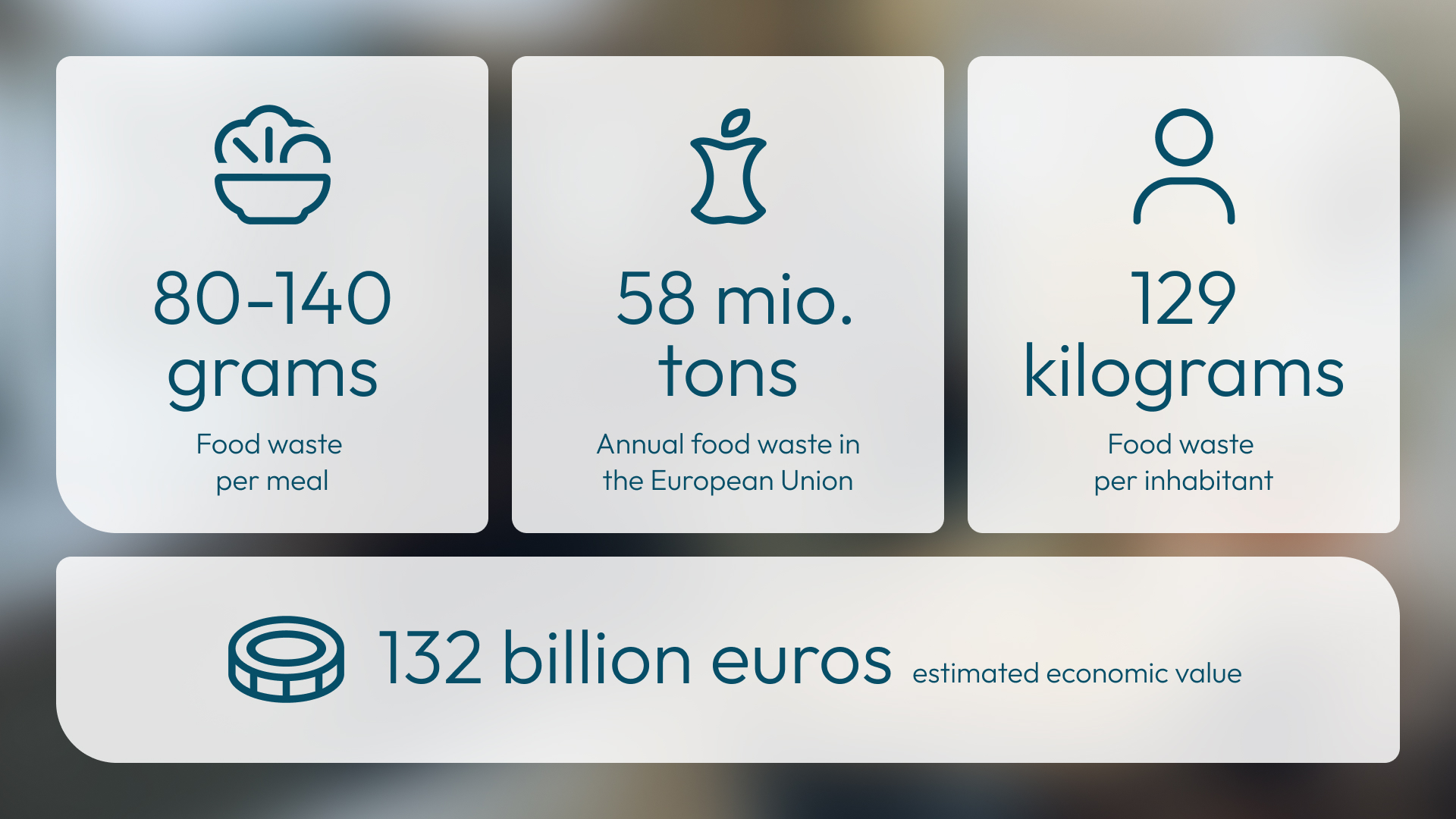
Company restaurants and canteens are among the areas of the food service industry with the highest waste rates. Studies show that each meal often generates between 80 and 140 grams of food waste (source: kikleo). The impact of this waste extends far beyond the individual canteen. In the European Union, more than 58 million metric tons of food waste are generated each year — that’s about 129 kg per capita — with an estimated economic value of approximately 132 billion euros (source: European Union). Food waste is therefore a significant economic factor as well as a sustainability issue.
Reducing food waste: Why data sovereignty is the most effective lever
Many canteen planning decisions are still based on experience rather than comprehensive data. Although point-of-sale sales figures are available, they are often not linked to pre-orders, inventory management and actual waste volumes. In practice, these systems often operate in isolation from each other, with no data flow between them. Consequently, it remains unclear which dishes were particularly popular, what quantities were actually needed and which factors influenced demand.
Every unsold portion incurs costs regardless of whether it is served later. The costs of goods, labour, energy, storage and logistics have already been incurred at this stage. With rising food and labour costs, every unnecessarily produced portion also becomes a cost factor.
The good news is that even a systematic analysis of a company’s own processes and database often leads to double-digit reductions in food waste. The key question, therefore, is not whether food waste can be reduced, but how planning can become more precise and decision-making more data-driven.
How data sovereignty works in practice: menio CateringOS
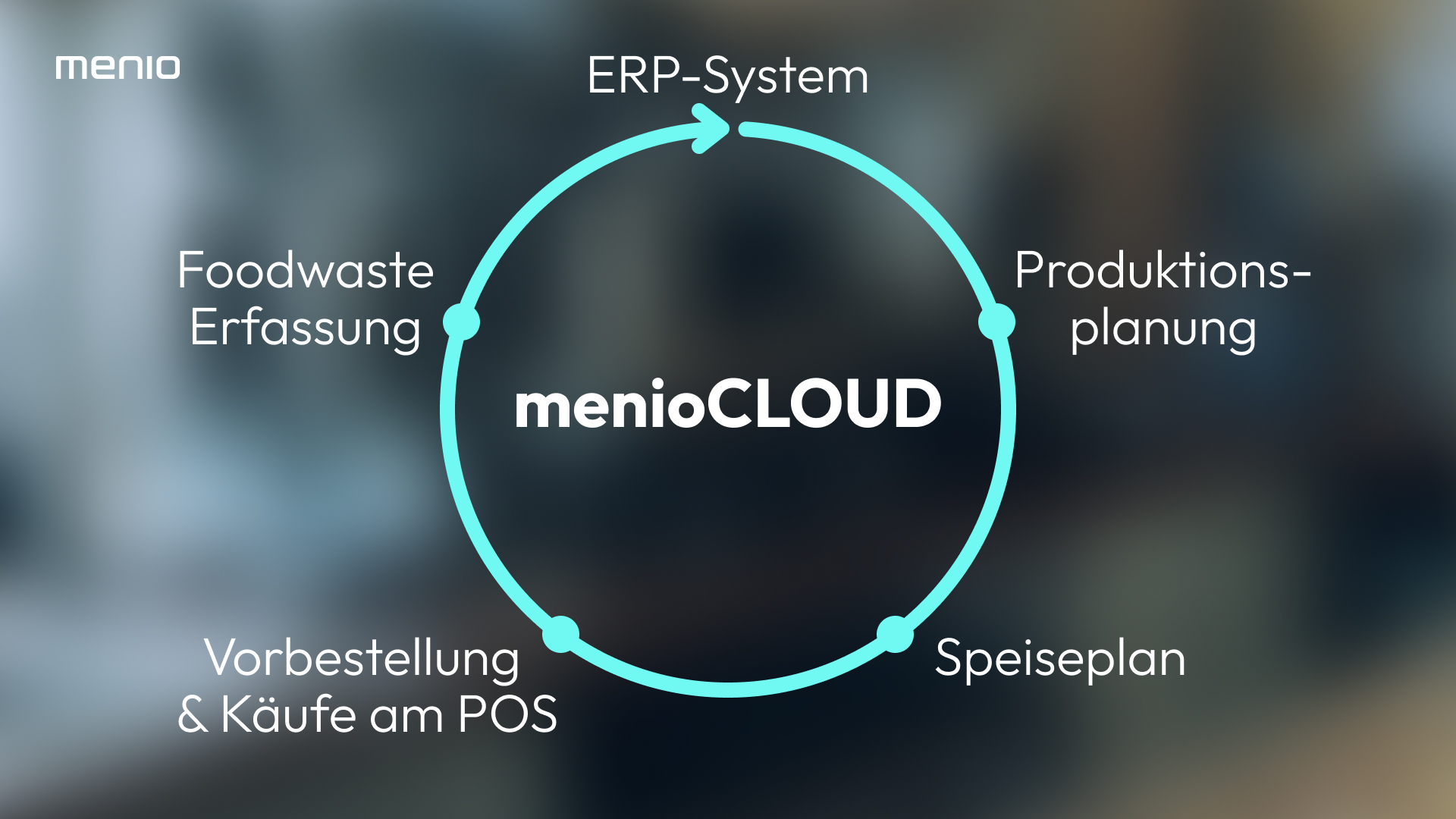
An integrated platform like menio CateringOS collects the data needed for accurate demand planning in one central location:
- Pre-order data from the menioApp or menioSOT shows early on how many guests have chosen which dish—rather than having the kitchen prepare meals based on past experience.
- Real-time sales figures from the point-of-sale system (menioPOS) provide, in addition to pre-orders, an up-to-date picture of what is actually in demand, even for spontaneous purchases made without a pre-order.
- Interfaces with common inventory management systems ensure that this aggregated demand data reaches the systems where purchasing and production volumes are actually managed
- Integrated food waste tracking tools close the loop: If waste is still generated despite better planning, it’s possible to measure exactly where and why—and this information is then incorporated into the next demand planning cycle.
The result is a closed-loop system rather than a series of individual tools. menio CateringOS ensures that all departments now work with the same up-to-date demand data for the first time — precisely the connection that is often missing in businesses today.
Five practical strategies to combat food waste — and how integrated data can enhance them.
- Establish a pre-ordering process. A user-friendly app for pre-order increases participation—and thus improves data quality for all subsequent steps.
- Feed order data into the procurement system. Automatically reconcile pre-order and point-of-sale data with the inventory management system instead of compiling it manually—this reduces both over- and under-ordering.
- Reduce the proportion of free-flow and buffet-style service. Plated meals can be prepared in a more demand-driven manner than a buffet that is constantly restocked; hybrid models with digital pre-ordering are helpful where the buffet is to remain.
- Implement waste measurement. Only by linking this data to order information can you determine whether overproduction, food waste, or inventory losses are the main drivers—on its own, this metric has no impact.
- Involve employees. Transparent communication about the impact of their own pre-orders motivates them to participate—and thus improves the quality of the planning data.
Reducing food waste: What specific savings can be made?
Every kilogramme of food waste incurs costs across the entire value chain. Even a small reduction in food costs can make a significant difference over the course of a year in contract catering, without requiring additional investment in food quality or staff.
For decision-makers in contract catering, this offers twofold benefits: lower costs through more precise planning, and a strong argument for sustainability reports and competitive bids, where reducing food waste is becoming an increasingly important evaluation criterion.
The next step: Not just analyzing data, but forecasting demand
A consistent database improves current production planning and lays the groundwork for more accurate forecasting of future demand. For example, AI-based forecasting models can combine historical sales and order data with factors such as the day of the week, menu offerings and season to determine likely required quantities.
However, the quality of the underlying data is crucial. If pre-orders, point-of-sale transactions, and other operational data are stored separately or structured differently, forecasts will remain incomplete. An integrated platform therefore not only provides greater transparency today but also lays the foundation for increasingly automated and predictive production planning.
Conclusion: Not more tools, but a platform that connects processes
Corporate canteens do not necessarily need to replace their existing inventory management systems or implement additional food waste tools to make tangible progress. The key lies in ensuring that pre-order, point-of-sale and inventory management data all operate on the same foundation. It is precisely this data sovereignty, achieved through an integrated platform, that distinguishes isolated measures with limited impact from an end-to-end process that reduces food waste sustainably.
Frequently asked questions about food waste in contract catering (FAQ)
Company canteens generate an average of over 100 grams of food waste per meal. With all-you-can-eat offerings, food waste can be significantly higher in some cases, as actual demand is more difficult to predict.
Pre-orders provide the kitchen with reliable quantity data before production begins. The higher the participation rate in a digital pre-order system, the more accurately the actual quantity needed can be planned—and the less overproduction there will be.
The combination of three data sources provides the most comprehensive picture: pre-order data (projected demand), point-of-sale data (actual sales in real time), and inventory management data (purchasing, inventory levels, cost of goods sold). An integrated platform brings these data sources together rather than treating them in isolation.
Even smaller locations benefit, as even minor improvements in demand planning can significantly reduce the cost of goods sold. Since menio integrates with existing systems via interfaces, it is often not necessary to completely overhaul the IT infrastructure.
Great things always begin with a conversation!
Efficient ways to digitize any contract catering just one-hour presentation.